 EN
 fr
 es
 ru
 ar

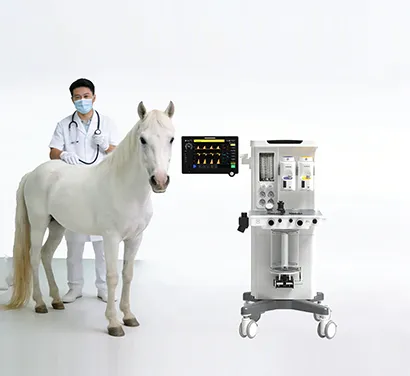
Set that against the companion-animal figures from the equivalent small-animal study: 0.17% in dogs and 0.24% in cats. A healthy horse undergoing an elective procedure carries roughly five to ten times the anesthetic risk of a dog, and the gap widens dramatically in emergencies.
| Horses, all cases (CEPEF 1–2) | 1.9% (785 deaths in 41,824 anesthetics) |
|---|---|
| Horses, excluding colic | 0.9% |
| Dogs, all cases (CEPSAF) | 0.17% — 0.05% in healthy ASA 1–2 patients |
| Cats, all cases (CEPSAF) | 0.24% — 0.11% in healthy ASA 1–2 patients |
| Rabbits, all cases (CEPSAF) | 1.39% — comparable to horses, and often overlooked |
Where the risk comes from
Three things make the horse a difficult anesthetic patient, and each one has an equipment consequence.
1 · Recumbency compromises breathing and circulation
A 500 kg animal lying down compresses its own dependent lung under the weight of the abdominal viscera and the thoracic wall. Ventilation-perfusion mismatch develops within minutes, and spontaneous ventilation becomes progressively inadequate. This is not an occasional complication — it is the expected course of events.
Equipment consequence: mechanical ventilation is a baseline requirement in equine anesthesia, not an upgrade for difficult cases. A large-animal machine without a ventilator has limited use beyond very short procedures.
2 · Tidal volumes are an order of magnitude larger
At roughly 10 mL/kg, a 500 kg horse needs about 5 litres per breath. A human adult needs about 0.5 litres; a 25 kg dog about 0.25 litres. Every gas-handling component has to be scaled accordingly.
Equipment consequence: large-bore breathing hoses (typically 50 mm rather than 22 mm), a bellows sized in litres rather than millilitres, one-way valves large enough not to impose resistance at those flows, and a CO₂ absorber canister with the capacity to handle the CO₂ load of a 500 kg animal. A circle system scaled for dogs will not simply work less well on a horse — the resistance alone makes it unusable.
3 · Recovery is the dangerous phase
A horse that wakes disoriented and attempts to stand before it has coordination can fracture a limb or injure itself and staff. A substantial share of equine anesthetic deaths occur during recovery rather than during the procedure itself.
Equipment consequence: a demand valve for oxygen supplementation during recovery, padded recovery facilities, and in many practices a hoist or rope-assisted recovery system. These are part of the anesthesia capital requirement even though they sit outside the machine itself.
What a large-animal machine must do differently
| Breathing hose diameter | Small animal 15–22 mm · Large animal typically 50 mm, to keep resistance acceptable at equine flows |
|---|---|
| Reservoir bag / bellows | Small animal 0.5–5 L · Large animal 15–30 L |
| CO₂ absorber | Small animal canisters measured in hundreds of millilitres · Large animal canisters measured in litres, with correspondingly higher soda lime consumption per case |
| Ventilator | Optional in small animal practice · Effectively mandatory in equine; must deliver multi-litre tidal volumes against the compliance of a large circuit |
| Endotracheal tubes | Small animal 2–14 mm internal diameter · Equine 18–30 mm, requiring a different cuff inflation and leak-check routine |
| Oxygen consumption | Scaled to body weight; cylinder logistics or a piped supply become a planning constraint rather than an afterthought |
| Positioning and recovery | Padded table and recovery box, hoist or rope system, demand valve — capital items with no small-animal equivalent |
| Monitoring | Invasive arterial blood pressure is routine rather than advanced in equine practice, because hypotension is common and cuff-based methods are less reliable on a horse |
The monitoring point deserves emphasis
The 2025 ACVAA guidelines place invasive arterial pressure measurement in the advanced tier for small animals. In equine anesthesia it is closer to standard practice. The reason is mechanical: a horse under inhalant anesthesia is reliably hypotensive, mean arterial pressure correlates directly with the risk of post-anesthetic myopathy, and oscillometric measurement on a limb is less dependable at equine body size.
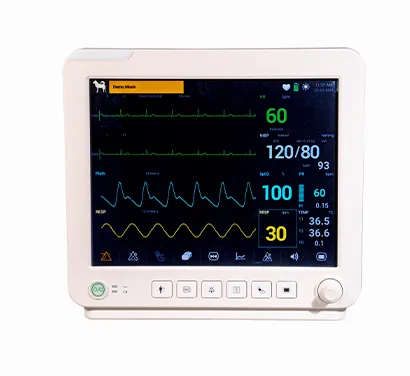
If you are specifying an equine setup, budget for a monitor with an invasive pressure channel and the associated transducer consumables. It is not an optional refinement in this species.
Questions to ask before buying a large-animal machine
- What is the maximum deliverable tidal volume, and at what circuit compliance was it measured?
- What is the bellows or reservoir capacity in litres?
- What is the CO₂ absorber canister capacity, and what is the expected soda lime consumption per hour at equine flows?
- What hose diameter does the circuit use, and are replacement hoses and connectors available in my country?
- Is a demand valve for recovery included or an accessory?
- What is the ventilator drive mechanism, and does it need a separate drive gas supply? At equine flows this materially affects gas logistics.
- What range of endotracheal tube sizes does the circuit accept?
- Does the package include an invasive blood pressure channel, or is that a separate monitor purchase?
- What is the footprint and weight, and can it be moved between a surgery and a recovery box?
- What is the service route in my country, and what is the lead time on a bellows or a valve assembly?
A note on mixed practice
Practices that see both small animals and horses sometimes ask whether one machine can cover both. It cannot, in any practical sense. The hose diameters, bellows volumes, absorber capacities and tidal volume ranges do not overlap. A mixed practice needs two machines, and the realistic decision is which one to buy first and how to phase the second.
The exception is the middle ground — calves, foals, small ruminants, llamas and alpacas in the 50–150 kg range. These can often be managed on a large-dog circle system, and a practice whose large-animal work is mostly in that band may not need a full equine setup at all. Define the actual weight distribution of your caseload before specifying equipment for the heaviest animal you might ever see.
Frequently asked questions
How much riskier is anesthesia in horses than in dogs?
Roughly ten times, on the published figures: 1.9% perioperative mortality in horses across all cases, against 0.17% in dogs. Excluding emergency colic surgery, the equine figure falls to 0.9%, which is still about five times the canine rate. The gap is driven by the physiological consequences of recumbency at that body mass and by the risk of injury during recovery.
Can a small-animal anesthesia machine be used on a horse?
No. The breathing circuit resistance, bellows volume and CO₂ absorber capacity are all an order of magnitude too small. A 500 kg horse needs roughly 5 litres per breath; a small-animal circle system is built for a fraction of that. It is a different class of equipment, not a smaller version of the same one.
Does a horse always need mechanical ventilation under anesthesia?
For anything beyond a very short procedure, effectively yes. A recumbent horse hypoventilates predictably because of the weight of its own viscera on the diaphragm and the compression of the dependent lung. Manual ventilation of a 15–30 litre bellows is not a practical substitute over a procedure of any length.
What is a demand valve and why do equine practices need one?
A demand valve delivers oxygen in response to the patient's own inspiratory effort, through a connection to the endotracheal tube. In equine practice it is used during the recovery phase, after the horse has been disconnected from the machine but before it is stable enough to stand. Given that a substantial proportion of equine anesthetic deaths occur during recovery, oxygen supplementation in that window is a meaningful intervention.
What about donkeys, cattle and camelids?
Cattle and adult camelids broadly share the equine equipment requirement, with ruminant-specific concerns around regurgitation and bloat that affect airway management more than machine specification. Donkeys differ pharmacologically from horses — they metabolise several anesthetic drugs differently — which affects protocol rather than equipment. Animals in the 50–150 kg band can usually be managed on a large-dog circle system.
Why is the rabbit mortality figure in the same range as the horse?
Different cause, similar outcome. In rabbits the problem is scale in the other direction: very small tidal volumes, high equipment dead space relative to those volumes, difficult intubation, and a species prone to stress-related complications. The CEPSAF figure of 1.39% is a reminder that both ends of the weight range are harder than the middle, and that equipment chosen for dogs serves neither end well.