 EN
 fr
 es
 ru
 ar

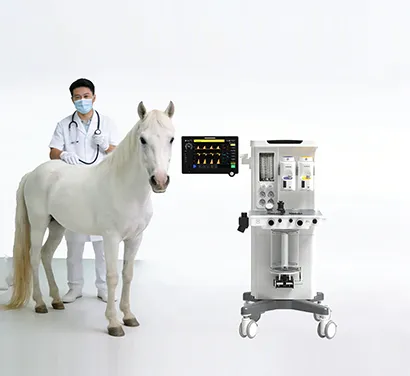
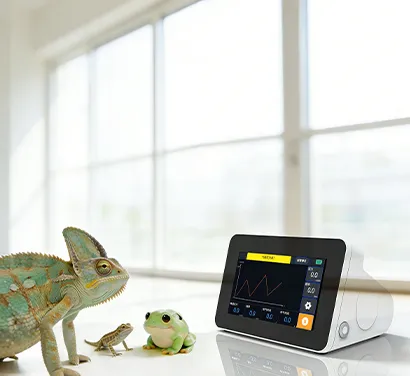
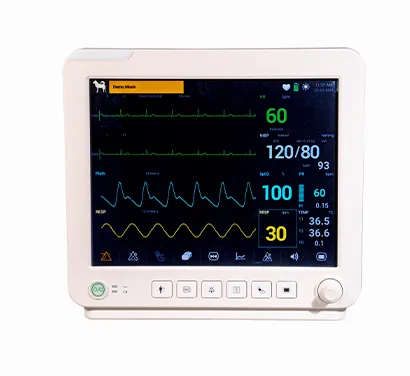
The difference is the patient. A human anesthesia machine is designed around an adult of 50–100 kg, with a paediatric mode reaching down to a neonate of about 3 kg. A veterinary machine in general practice has to serve a 0.5 kg rabbit and a 70 kg dog from the same trolley, and an equine machine starts where the human range ends. Everything below follows from that.
The seven differences that matter
| 1 · Patient weight span | |
|---|---|
| Human | Roughly 3–150 kg — a 50-fold span, and the low end is a specialist neonatal configuration. |
| Veterinary (small animal) | 0.02–90 kg routinely, from a mouse to a giant-breed dog — a span of several thousand-fold across the species a mixed practice sees. |
| Consequence | No single veterinary machine covers the whole range. The practical question is not "is this machine good" but "which band of patients is it accurate in". |
| 2 · Minimum deliverable tidal volume | |
| Human | Ventilators are typically specified from about 20–50 mL upward. |
| Veterinary | A 2 kg cat at 10 mL/kg needs roughly 20 mL per breath; a 0.4 kg rat needs about 4 mL. Below the ventilator's accurate range, delivered volume becomes guesswork. |
| What to ask | The minimum tidal volume in millilitres and the stated accuracy at that volume — not just the range endpoints. |
| 3 · Equipment dead space | |
| Human | A Y-piece and elbow adding 15–25 mL is negligible against a 500 mL adult tidal volume. |
| Veterinary | The 2020 AAHA guidelines cap equipment dead space at 2–3 mL/kg, or 20% of tidal volume. For a 2 kg cat that is 4–6 mL total — smaller than many standard human connectors. |
| Consequence | Human patient-side connectors used on a small animal can rebreathe a significant fraction of each breath. This is the most common and least visible way a repurposed human machine harms a small patient. |
| 4 · Breathing circuit range | |
| Human | Adult and paediatric circle systems; non-rebreathing circuits are a specialist item. |
| Veterinary | Must switch between a circle system above roughly 3–5 kg and a non-rebreathing (Mapleson) circuit below it. An ACGO outlet to divert fresh gas to a non-rebreathing circuit is a standard veterinary requirement and an uncommon human one. |
| 5 · Vaporizer agents | |
| Human | Sevoflurane and desflurane dominate; isoflurane use has declined in many markets. |
| Veterinary | Isoflurane remains the workhorse on cost grounds, with sevoflurane used where faster recovery justifies the price. Halothane persists in some markets. Vaporizers are agent-specific and not interchangeable. |
| Consequence | A human machine supplied with a desflurane vaporizer is of no use in a practice running isoflurane, and the vaporizer is a substantial share of the machine's cost. |
| 6 · Scavenging and staff exposure | |
| Human | Operating theatres have engineered active scavenging and air-change rates as building infrastructure. |
| Veterinary | Procedures often happen in a converted room without piped suction, with staff standing closer to the patient for longer. Passive charcoal scavenging is common and markedly less effective than active. |
| Consequence | Waste gas handling deserves more attention in a veterinary setting than in a hospital, not less — the opposite of what equipment budgets usually assume. |
| 7 · Regulatory route | |
| Human | Medical device regulation: EU MDR / CE marking, US FDA 510(k), national registration. Long, expensive, heavily documented. |
| Veterinary | In most jurisdictions veterinary devices sit outside human medical device regulation. CE marking and ISO 13485 may still be held by the manufacturer, but the legal requirement differs by country. |
| Consequence | Certification claims must be read carefully. Ask which certificate covers which specific model, and whether the scope is veterinary, human, or both. |
Why the comparison comes up at all
Two situations drive the question in practice.
A practice is offered a decommissioned human machine. These appear on the second-hand market cheaply. For large dogs and horses they can work. For cats, rabbits and exotics the tidal volume floor and the connector dead space are real clinical limits, not marketing points. The honest answer is that it depends entirely on the lightest patient on your surgery list.
A buyer is benchmarking a veterinary machine against a familiar human brand. This is a reasonable instinct — human-market manufacturers are held to a documented standard and a buyer wants that assurance. The useful comparison is not brand against brand but specification against specification, on the points above: minimum accurate tidal volume, low-end flowmeter resolution, dead space in millilitres, vaporizer agent and compensation, and what certification covers the exact model.
Where the two converge
Above roughly 20 kg, the clinical gap narrows considerably. A 40 kg dog and a 40 kg child place similar demands on a circle system. This is why the large-animal and large-dog segments see the most crossover equipment, and why equine machines often borrow human ICU ventilator technology — a 500 kg horse needs tidal volumes an order of magnitude above a human adult, but the engineering problem is the same kind of problem, just scaled up rather than down.
Scaling down is the harder direction. Delivering 4 mL accurately is a different engineering problem from delivering 500 mL accurately, and it is the reason purpose-built small-animal and laboratory machines exist at all.
A buyer's checklist
If you are comparing a veterinary machine with a human one, or with another veterinary machine, these are the questions that separate them. Ask for numbers, not adjectives.
- What is the lightest patient this machine can ventilate mechanically, and what is the delivered-volume accuracy at that weight?
- What is the flowmeter's full range, and is there a separate low-flow tube for flows under 1 L/min?
- What is the dead space, in millilitres, of the patient-side connectors you ship?
- Which agent is the vaporizer calibrated for, is it temperature- and flow-compensated, and what is the recalibration interval?
- Are a manometer and an APL valve fitted as standard, or options?
- Is there an ACGO for a non-rebreathing circuit?
- What is the CO₂ absorber canister capacity, and is replacement absorbent available in my country?
- Is scavenging active or passive, and what is supplied in the box?
- Which certificates cover this exact model, and what is their scope?
- What is the service and spare-parts route in my country, and what is the typical lead time for a part?
Frequently asked questions
Is a veterinary anesthesia machine just a cheaper human machine?
No. The price difference mostly reflects a simpler regulatory route and a smaller production scale, not a reduced gas path. The engineering difference that matters runs in the other direction: a small-animal machine has to be accurate at flows and volumes a human machine never has to reach.
Can I use a human ventilator on a dog?
For a dog above roughly 20 kg, usually yes, provided the circuit and connectors are appropriate and the tidal volume sits comfortably inside the ventilator's accurate range. Below that weight, and for cats, rabbits and exotics, check the minimum deliverable tidal volume and its accuracy before assuming it will work.
Why do veterinary machines still use isoflurane when human anesthesia has largely moved on?
Cost per case. Isoflurane is substantially cheaper than sevoflurane and the slower recovery it produces is usually acceptable in a veterinary setting where the patient recovers in a kennel under observation rather than in a staffed post-anesthetic care unit. Sevoflurane is chosen where faster, smoother recovery matters — brachycephalic patients, high-turnover practices, some exotics.
Does a veterinary anesthesia machine need CE marking or FDA clearance?
It depends on your jurisdiction. In most countries veterinary devices are not regulated under the human medical device framework, so the legal requirement differs from the human equivalent. Many manufacturers nonetheless hold ISO 13485 and CE certification. What matters commercially is whether the certificate names the model you are buying and whether its scope covers veterinary use in your market — several importers have discovered at customs that a certificate covered a different model in the same family.
What single specification most often gets overlooked?
Equipment dead space in millilitres. It is rarely printed on a spec sheet, it is invisible in a demonstration, and it is the specification that decides whether a machine is safe for patients under 5 kg.