 EN
 fr
 es
 ru
 ar

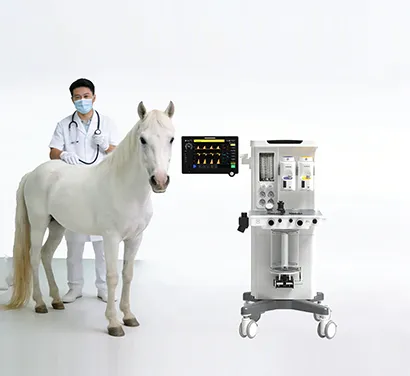
The issue is more acute in veterinary medicine than in human hospitals, for reasons that have nothing to do with clinical standards. Human operating theatres are purpose-built with engineered extraction and high air-change rates. Veterinary procedures often take place in converted rooms, with staff standing closer to the patient for longer, frequently using uncuffed tubes or masks, and commonly scavenging passively into a charcoal canister.
The exposure limits
| Halogenated agent alone (isoflurane, sevoflurane, halothane) | 2 ppm, for no more than 1 hour |
|---|---|
| Halogenated agent used with nitrous oxide | 0.5 ppm over 1 hour |
| Nitrous oxide alone | 25 ppm, time-weighted average |
Two parts per million is a small number. For context, the concentration delivered to a patient is measured in whole percentage points — 1.28% isoflurane is 12,800 ppm. The limit for room air is roughly one six-thousandth of that. A leak that would be imperceptible as a smell can exceed it.
Limits vary between countries; the figures above are the NIOSH recommendations. Check what applies in your jurisdiction, because in some markets these are enforceable rather than advisory.
What chronic exposure is associated with
The evidence base here is mixed in quality, and it is worth being precise about what is established and what is not.
| Short-term symptoms | Fatigue, headache, dizziness, irritability — the complaints most often reported by staff working in poorly scavenged areas |
|---|---|
| Haematological | Lower red blood cell counts reported; white cell findings are conflicting |
| Hepatic | Raised liver enzymes (AST, ALT, GGT, ALP) in exposed personnel |
| Reproductive | Some reports associate poorly ventilated, non-scavenged operating rooms with higher miscarriage or preterm delivery risk. Where scavenging and ventilation are adequate, the evidence shows no increased risk. |
| Congenital abnormalities | Evidence is limited and inconsistent |
| Genotoxicity | Some studies suggest possible DNA effects from prolonged exposure |
The reproductive line is the one to read carefully, and it is the most useful finding on this page. The association is with poorly ventilated, non-scavenged rooms. Where scavenging and ventilation are adequate, the elevated risk is not seen. This is a solvable problem, and the solution is equipment and ventilation rather than staff avoidance.
Where the gas actually escapes
Leakage is rarely one dramatic failure. It is the sum of several small, routine sources:
- The machine and circuit — the leaks a pre-use pressure test is designed to catch. A circuit that fails its leak test is also an exposure problem.
- Uncuffed endotracheal tubes — common in small patients, where a cuff may not be appropriate. Gas escapes around the tube on every breath.
- Poorly fitted masks and open induction chambers — mask induction is a significant source, and opening a chamber releases its entire contents into the room.
- The patient during recovery — an extubated animal exhales agent for some time afterwards, in a recovery area that usually has no scavenging at all.
- Vaporizer filling — a spill or an open filler port releases liquid agent that evaporates immediately.
- A failing scavenging system — a saturated charcoal canister looks identical to a fresh one and scavenges nothing.
Active vs passive scavenging
| Active scavenging | |
|---|---|
| How it works | A suction source or dedicated extraction fan draws waste gas from the APL valve and ventilator exhaust and vents it outside the building |
| Strengths | Substantially more effective; no consumable to forget; handles nitrous oxide, which charcoal does not adsorb |
| Requirements | A suction source or fan, ducting to outside, and an interface that prevents excessive negative or positive pressure reaching the patient circuit |
| Passive scavenging — charcoal canister | |
| How it works | Waste gas passes through activated charcoal, which adsorbs halogenated agent |
| Strengths | Cheap, portable, no installation — the practical option for mobile work and rooms with no duct route |
| Limitations | Finite capacity; must be weighed and replaced at the manufacturer's stated weight gain, not by appearance; does not adsorb nitrous oxide at all; adds resistance to the expiratory limb as it loads |
| Passive scavenging — tube to outside | |
| How it works | Waste gas is routed through tubing directly to outside air |
| Limitations | Depends on tube length, diameter and wind; back-pressure can reach the patient circuit; easily defeated by a kinked or blocked line |
If a machine is being specified for a room where ducting is possible, active scavenging is the better engineering answer and the cost difference is modest against the machine. Where it is not possible, a charcoal canister with a disciplined weighing routine is the realistic alternative — but the discipline is the whole point. An unweighed canister is decoration.
Ventilation: the control that is easy to forget
Scavenging captures gas at the machine. Room ventilation deals with what escapes anyway — from masks, chambers, uncuffed tubes and recovering patients. Recommended air change rates:
| Operating room | At least 15 air changes per hour |
|---|---|
| Recovery room | At least 6 air changes per hour |
Recovery areas are the commonly overlooked case. The patient is still exhaling agent, there is no scavenging, and staff are often working closely with the animal. A recovery area with no meaningful air exchange can be the highest-exposure location in the building.
Practical controls, in order of effectiveness
- Eliminate or substitute where clinically appropriate. Total intravenous anesthesia and regional or local techniques produce no waste gas at all. Avoiding nitrous oxide removes the agent charcoal cannot capture and lowers the combined limit from 0.5 ppm back to 2 ppm.
- Use low-flow technique on a circle system. Less fresh gas in means less waste gas out, with the caveat that low-flow sevoflurane warrants more attention to absorbent condition.
- Scavenge actively where the building allows it.
- Ventilate the room — 15 air changes per hour in theatre, 6 in recovery.
- Leak test before every anesthetic. The same test that protects the patient protects the staff.
- Fill vaporizers in a ventilated area, ideally outside working hours, using a keyed filling system that minimises spill.
- Do not open the vaporizer until the circuit is connected to the patient, and close it before disconnecting.
- Use closed induction chambers and scavenge them on opening rather than venting into the room.
- Weigh charcoal canisters on a schedule and replace at the stated gain.
- Train staff, and make the protocol part of the pre-anesthetic checklist the 2025 ACVAA guidelines already recommend.
Frequently asked questions
What is the exposure limit for isoflurane and sevoflurane?
NIOSH recommends no more than 2 ppm of a halogenated agent used alone, measured over no more than one hour. If the agent is used together with nitrous oxide, the limit falls to 0.5 ppm. Nitrous oxide alone has a 25 ppm time-weighted average limit. Limits differ between countries, so check local regulation.
Is a charcoal canister enough?
It is better than nothing and is the practical choice where ducting is impossible, but it is less effective than active scavenging, it has finite capacity, and it does not adsorb nitrous oxide at all. If you use one, weigh it on a schedule and replace it at the manufacturer's stated weight gain — a saturated canister is visually indistinguishable from a fresh one.
Can I smell anesthetic gas at dangerous levels?
Smell is not a reliable indicator. The recommended limit of 2 ppm is far below the concentration delivered to a patient and well below the level at which most people reliably detect an odour. If you can smell agent, the concentration is likely well above the recommendation — but not smelling it does not mean the room is clean.
Is waste anesthetic gas a risk in pregnancy?
Some reports associate poorly ventilated, non-scavenged operating rooms with higher miscarriage and preterm delivery risk. Importantly, where scavenging and ventilation are adequate, that elevated risk is not seen. The practical answer is to fix the scavenging and ventilation rather than to manage it by staff rota, and for anyone with specific concerns to discuss them with their own physician.
Where is exposure highest in a veterinary practice?
Often the recovery area rather than the theatre. Patients continue exhaling agent after extubation, there is usually no scavenging, air change rates are lower, and staff work close to the animal. Mask induction and opening induction chambers are the other high-exposure moments.
Does low-flow anesthesia reduce staff exposure?
Yes. Less fresh gas entering the circle system means less waste gas leaving it, so low-flow technique reduces both agent cost and room contamination. The caveat is that low-flow sevoflurane increases Compound A formation and places more demand on absorbent condition, so it requires a stricter absorbent replacement routine.