 EN
 fr
 es
 ru
 ar

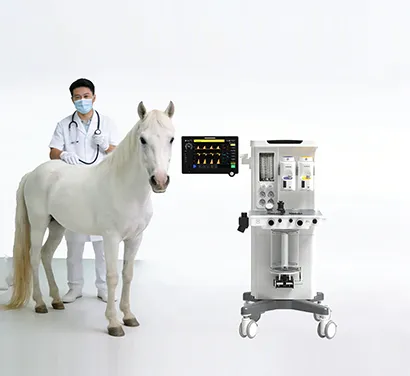
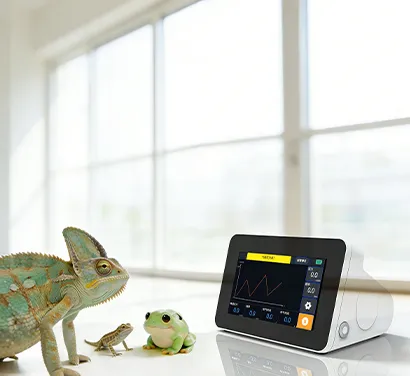
The term covers a wide range of equipment, from a 9 kg tabletop unit for rodents to a 200 kg equine workstation. What makes a machine veterinary rather than human is not the gas path — that is largely the same — but the range it has to cover. A single small-animal practice may anesthetize a 0.3 kg rat and a 70 kg mastiff in the same week. No human anesthesia machine is designed for a 200-fold span in patient weight.
The gas path, in order
Follow the oxygen from the cylinder to the patient and back, and the machine explains itself.
| 1 · Gas supply | |
|---|---|
| Oxygen source | Cylinder (E or H size), oxygen concentrator, or piped wall supply. Supplies oxygen at roughly 280–600 kPa (41–87 psi). |
| Pressure regulator | Drops cylinder pressure (up to ~13,800 kPa) to a constant working pressure so flow does not change as the cylinder empties. |
| Oxygen flush | Bypasses the vaporizer and delivers high-flow pure oxygen directly to the circuit. Used to fill the bag fast — never with the patient connected and the pop-off closed. |
| 2 · Flow control | |
| Flowmeter | Sets oxygen delivery in litres per minute. The low end matters more than the high end: a circle system at maintenance may need only 500 mL/min, which a flowmeter starting at 1 L/min cannot deliver accurately. |
| 3 · Agent delivery | |
| Vaporizer | Adds volatile agent to the oxygen stream at a dialled percentage. Agent-specific: an isoflurane vaporizer cannot be filled with sevoflurane. Precision vaporizers are temperature- and flow-compensated so the delivered concentration stays at the dial setting across a range of conditions. |
| Common gas outlet | Where the oxygen-plus-agent mixture leaves the machine and enters the breathing circuit. An ACGO (auxiliary common gas outlet) lets you divert this mixture to a non-rebreathing circuit. |
| 4 · Breathing circuit | |
| Rebreathing (circle) system | For patients above roughly 3–5 kg. Exhaled gas passes through a CO₂ absorber and is re-inhaled, so fresh gas flow can be low (20–40 mL/kg/min, minimum 500 mL/min). |
| Non-rebreathing (Mapleson) system | For patients below roughly 3–5 kg. No absorber and almost no resistance; CO₂ is flushed out by high fresh gas flow (~200–400 mL/kg/min). |
| CO₂ absorber canister | Holds soda lime, which chemically removes exhaled CO₂. Capacity is typically given in millilitres or grams; absorbent is replaced after about 8 hours of use. |
| One-way valves | Force gas to travel in one direction around the circle, keeping fresh and exhaled gas separate. |
| Reservoir bag | Accommodates the patient's peak inspiratory demand and lets the anesthetist ventilate by hand and feel compliance. |
| Manometer | Displays airway pressure. Required for the standard leak test and for safe manual ventilation. |
| APL (pop-off) valve | Vents excess gas and limits circuit pressure. The single most dangerous control on the machine when left closed. |
| 5 · Waste gas handling | |
| Scavenging system | Collects gas vented from the APL valve and ventilator. Active scavenging (suction-driven) is substantially more effective than passive (charcoal canister or tube to outside) and is the staff-exposure control. |
What a machine is not: monitoring
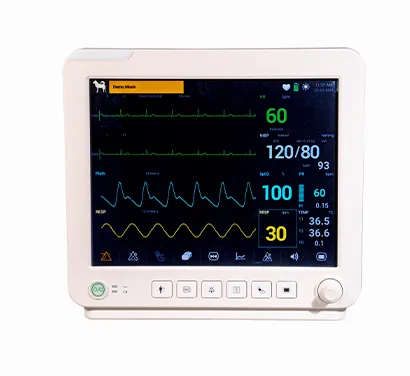
An anesthesia machine delivers gas. It does not tell you how the patient is responding. That is the monitor's job, and the two are separate purchases on most veterinary machines even when they are mounted on the same trolley.
The 2025 ACVAA Small Animal Anesthesia and Sedation Monitoring Guidelines set out what counts as minimum monitoring for an anesthetized small-animal patient:
| Circulation | Continuous ECG; oscillometric blood pressure at least every 5 minutes; time-based capnography; hands-on assessment of pulse, heart sounds and capillary refill time. |
|---|---|
| Oxygenation | Pre-anesthesia equipment check; mucous membrane colour and ventilatory effort; pulse oximetry in heavily sedated or anesthetized patients. |
| Ventilation | Observation of chest or bag movement; auscultation; airway pressure manometer; time-based capnography. |
| Temperature | Rectal or esophageal temperature, checked at least every 15 minutes under sedation or anesthesia and at least every 30 minutes in recovery. |
Two of those four — the airway pressure manometer and the equipment check — are properties of the machine itself. If a machine ships without a manometer, it cannot meet the minimum standard, whatever monitor you pair it with.
The numbers that trigger action
These thresholds come from the 2025 ACVAA guidelines and are worth knowing before you compare equipment, because they define what your machine and monitor have to be able to detect.
| Mean arterial pressure | Below 60–65 mmHg — assess and intervene |
|---|---|
| Doppler systolic pressure | 90 mmHg or below — assess and intervene |
| SpO₂ | Below 95% — investigate, including technical causes |
| End-tidal CO₂ | Above 60 mmHg — address |
| Inspired CO₂ | Should be at or near 0 mmHg — a rise indicates absorbent exhaustion or a valve fault |
| Body temperature | Below 37.8 °C (100 °F) — begin active external warming |
| Endotracheal cuff | Inflate to no audible leak at approximately 20 cmH₂O |
Note what the inspired CO₂ threshold implies. A reading above zero is usually a machine fault, not a patient problem — exhausted soda lime or a stuck one-way valve. Capnography monitors the patient and audits the machine at the same time.
How much does the equipment actually matter?
The Confidential Enquiry into Perioperative Small Animal Fatalities (CEPSAF) remains the largest study of anesthetic death risk in companion animals:
| Dogs | 0.17% overall (1 in 601) — 0.05% in healthy ASA 1–2 patients, 1.33% in ASA 3–5 |
|---|---|
| Cats | 0.24% overall (1 in 419) — 0.11% in ASA 1–2, 1.40% in ASA 3–5 |
| Rabbits | 1.39% overall (1 in 72) — 0.73% in ASA 1–2, 7.37% in ASA 3–5 |
The pattern to take from this is that patient status dominates: a sick dog carries roughly 25 times the risk of a healthy one. Equipment cannot change a patient's ASA grade. What it can change is whether a deterioration is detected in time — which is why the machine's manometer, the capnograph and a functioning scavenging system earn their place, and why the rabbit figure is a warning to anyone anesthetizing exotics on equipment sized for dogs.
Frequently asked questions
Can a human anesthesia machine be used on animals?
Mechanically it will deliver gas, but it is the wrong tool for most veterinary patients. Human machines are built around a tidal volume range that starts well above what a cat or rabbit needs, their circuits and connectors carry dead space that is acceptable for a 70 kg adult and dangerous for a 2 kg patient, and their ventilators often cannot deliver small enough breaths. For patients in the 20–80 kg range the mismatch is smaller, which is why repurposed human machines are most often seen in large-dog and equine settings.
What is the difference between a rebreathing and a non-rebreathing circuit?
A rebreathing (circle) system recycles exhaled gas through a soda lime absorber, so fresh gas flow can be low and agent cost is low, at the price of some breathing resistance. A non-rebreathing system has almost no resistance but relies on high fresh gas flow to flush CO₂ away, so it uses several times more oxygen and agent. The patient's weight decides: below roughly 3–5 kg, the resistance of a circle system matters more than the gas cost.
How often does soda lime need to be replaced?
After about 8 hours of use, or sooner if the colour indicator changes or inspired CO₂ rises above zero on the capnograph. Colour indicators can revert after the canister rests, so hours of use and capnography are more reliable than colour alone.
Does every veterinary anesthesia machine need a ventilator?
No. For short procedures on healthy patients, manual ventilation with a working pop-off valve and manometer is adequate. A mechanical ventilator becomes necessary for procedures beyond roughly 60–90 minutes, thoracic surgery, cases using neuromuscular blockade, and any case where end-tidal CO₂ stays above 60 mmHg.
What is the minimum equipment needed to anesthetize a cat safely?
A machine with an oxygen source, a flowmeter that is accurate at low flows, an agent-specific precision vaporizer, a breathing circuit appropriate to the weight, a manometer, a functioning APL valve and a scavenging system — plus monitoring that covers circulation, oxygenation, ventilation and temperature, and a designated person whose only job during the procedure is the patient.
What is equipment dead space and why does it matter in small patients?
Dead space is the volume of gas in the connectors between the endotracheal tube and the Y-piece that gets rebreathed. The 2020 AAHA guidelines put the acceptable limit at 2–3 mL/kg, or no more than 20% of tidal volume. For a 2 kg cat that is 4–6 mL in total — less than the internal volume of some capnograph adapters and elbow connectors. Ask any supplier for the dead space of the patient-side connectors in millilitres.